
By Vanguard 360 Solutions · 21 July 2026
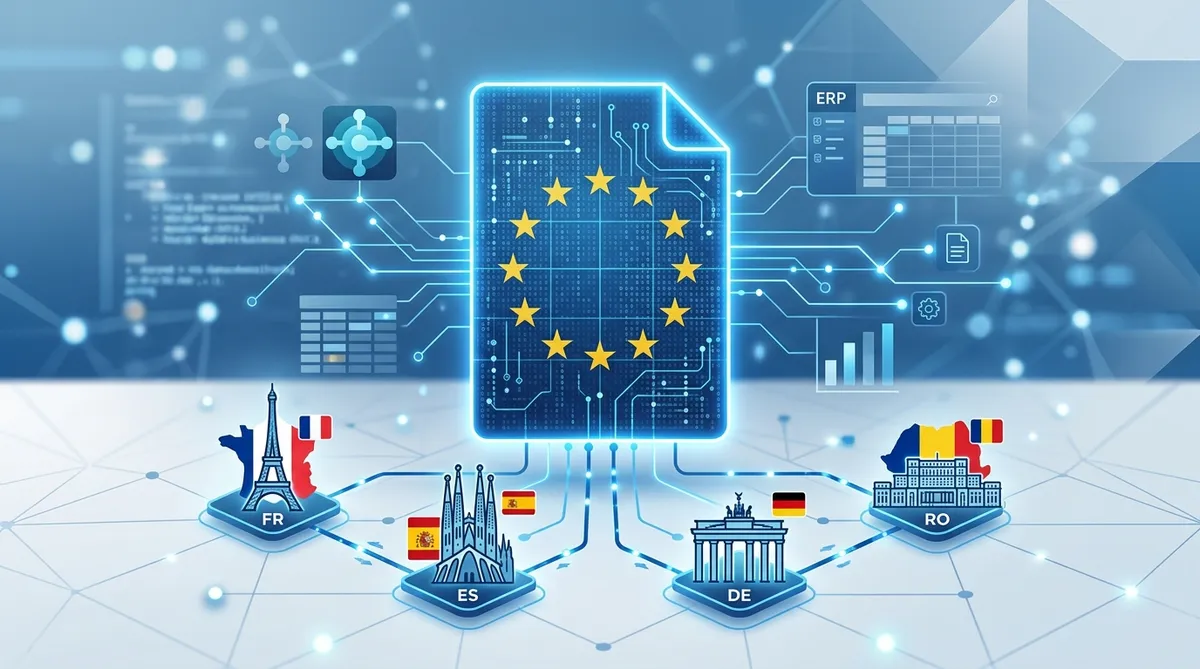
If you run Business Central and operate in the European Union, e-invoicing compliance isn’t something you can put off until next year. Deadlines are landing now. France goes live with B2B e-invoicing for large companies in September 2026. Belgium’s mandate is already in force since January. Germany requires all businesses to receive e-invoices — and has since January 2025. Romania’s RO e-Factura has been mandatory since 2024. Spain’s Verifactu and Crea y Crece frameworks are rolling out through 2026–2027.
The question isn’t “do we need to comply?” — it’s “does standard Business Central cover this, and if not, what’s the gap?”
This article maps the landscape: what each country requires, what Business Central supports natively, what it doesn’t, and a practical 3-step plan to get compliant before your deadline. No fluff. Real dates, real menu paths, real gaps.
What EU e-Invoicing Actually Means
Before diving into country-by-country requirements, it’s worth understanding what “e-invoicing” actually means in the EU context — because it’s not the same as emailing a PDF.
EN 16931: The European Norm
At the center of everything is EN 16931, the European standard for electronic invoicing. It defines a semantic data model for the core elements of an electronic invoice — what data must be present, how it must be structured, and what formats are compliant. It doesn’t prescribe one single file format. Instead, it allows several “syntax bindings” that implement the semantic model:
- UBL 2.1 (Universal Business Language) — XML-based, the most common in Peppol
- UN/CEFACT CII (Cross-Industry Invoice) — XML-based, used in France and Italy
- Factur-X / ZUGFeRD — hybrid PDF/A-3 with embedded XML, popular in France and Germany
Any invoice that conforms to EN 16931 is, in principle, interoperable across EU borders. In practice, member states layer additional requirements on top — country-specific tax categories, clearance models, and reporting obligations.
B2G: Already Mandated (Since 2020)
Directive 2014/55/EU required all EU member states to enable B2G (business-to-government) electronic invoicing by April 2019, with mandatory compliance by April 2020. If you invoice a public-sector entity anywhere in the EU, you’ve been sending structured e-invoices for years — or you should have been.
Most member states implemented this through national platforms: France uses Chorus Pro, Italy uses SdI, Germany uses XRechnung for federal procurement. This B2G infrastructure is now the foundation upon which B2B mandates are being built.
B2B: Rolling Out Now (2024–2028)
B2B e-invoicing is the current wave. Each member state is rolling out its own mandate, with its own timeline, its own technical requirements, and its own compliance model. There is no single “EU B2B e-invoicing deadline.” There are 27 different deadlines, and they’re not coordinated.
ViDA: What Changes from 2028–2030
The VAT in the Digital Age (ViDA) directive, formally adopted in March 2025, is the EU’s attempt to harmonize this fragmentation. ViDA introduces:
- Digital Reporting Requirements (DRR): mandatory near-real-time transaction data reporting to tax authorities across all member states
- Mandatory e-invoicing for intra-EU B2B transactions from July 2030
- EN 16931 as the mandatory format for cross-border intra-EU invoices
ViDA doesn’t replace national mandates — it layers a cross-border requirement on top. If you’re already compliant with your domestic e-invoicing mandate via an EN 16931-based format, you’re well-positioned for ViDA. If you’re still emailing PDFs and calling them invoices, ViDA means you’ll need to overhaul your invoicing infrastructure across every EU entity — and the clock is already ticking.
Country-by-Country: The Deadlines That Matter
Here’s what you need to know about the six countries where mandates are already live or imminent.
| Country | B2G Mandate | B2B Mandate | Format(s) | Clearance Model | BC Native Support |
|---|---|---|---|---|---|
| Italy | Jan 2019 | Jan 2019 (all) | FatturaPA (XML) | Central clearance (SdI) | Localization required |
| Romania | Jul 2022 | Jan 2024 (B2B), Jan 2025 (B2C) | RO e-Factura (XML) | Central clearance (ANAF) | No — requires ISV |
| Germany | Nov 2020 | Jan 2025 (receive), Jan 2027/2028 (send) | XRechnung, ZUGFeRD | Decentralized (EN-compliant exchange) | Yes — Peppol BIS 3, XRechnung (UBL) |
| Belgium | Mar 2024 | Jan 2026 (all B2B) | Peppol BIS 3.0 | Decentralized (Peppol) | Yes — Peppol BIS 3 |
| France | Jan 2020 | Sep 2026 (receive all, send large), Sep 2027 (send SME) | Factur-X, UBL, CII | Hybrid — PDP or PPF | Yes (2026 Wave 1) — via PDP |
| Spain | Jan 2015 | 2026–2027 (Verifactu + Crea y Crece) | FacturaE, Verifactu XML | Real-time + offline (SIF) | Partial — via B2Brouter connector |
| Poland | Apr 2019 | Feb 2026 (large), Apr 2026 (all) | KSeF XML | Central clearance (KSeF) | Localization required |
France: September 2026 — Act Now
France’s B2B e-invoicing mandate goes live 1 September 2026. From that date:
- All VAT-registered businesses must be capable of receiving electronic invoices
- Large companies (5,000+ employees or €1.5B turnover) must also issue e-invoices
- Mid-size companies (ETIs: 250–5,000 employees) must also issue e-invoices
- SMEs and micro-enterprises must issue from 1 September 2027
- A transitional period allows PDF submission through a PDP until December 2027
France uses a 5-corner model: the supplier sends to their certified Plateforme de Dématérialisation Partenaire (PDP), which validates the invoice, delivers it to the buyer’s PDP, and transmits data to the Portail Public de Facturation (PPF) for tax reporting. Chorus Pro — the existing B2G platform — serves as the PPF backbone for data aggregation but does not directly handle B2B invoice exchange.
Formats accepted: Factur-X (PDF/A-3 with embedded XML), UBL 2.1, CII, and Peppol BIS 3.0 for cross-border interoperability.
What Business Central does: Microsoft announced native French e-invoicing support in the 2026 Wave 1 release, using the standard E-Document framework. The localization app generates both Peppol BIS 3 and Factur-X formats. Crucially, Microsoft does not operate as a PDP — you’ll connect through a certified PDP provider using the E-Document service connector. You also get transaction e-reporting for operations where full structured invoices aren’t required.
Spain: Verifactu + Crea y Crece — Two Mandates, One Headache
Spain runs two parallel e-invoicing frameworks:
Verifactu (Anti-Fraud Law 11/2021): requires all invoicing software to generate tamper-proof records with cryptographic hash chaining, event logs, and QR codes. Real-time submission to AEAT is mandatory for certain companies (Verifactu mode), while others can use offline SIF (Sistema de Información de Facturación) with records stored locally. Deadlines:
- 1 January 2027: companies subject to Corporate Income Tax
- 1 July 2027: sole traders and other taxpayers
Businesses with turnover over €6 million already using SII (Suministro Inmediato de Información) are exempt from Verifactu — SII counts as compliance.
Ley Crea y Crece (Law 18/2022): mandates structured B2B e-invoicing via FacturaE format. Timeline: 12 months after publication of final regulation for companies over €8M turnover, 24 months for all others. Currently expected to begin phase-in during 2026–2027.
What Business Central does: Microsoft released embedded Verifactu mode in BC 2026 Wave 1. It uses the E-Document framework with a B2Brouter connector that auto-submits invoices to AEAT and embeds the official QR code. It’s a big step forward — but it requires a B2Brouter account (third-party service with its own fees) and is not yet fully embedded without third-party integration. For Crea y Crece B2B e-invoicing (FacturaE), you’ll likely need an additional ISV solution or connector.
Germany: Receive Now, Send Later
Germany’s mandate is phased but already active:
- 1 January 2025: all businesses must be capable of receiving e-invoices in EN 16931-compliant format
- 1 January 2027: businesses with revenue over €800,000 must also send e-invoices
- 1 January 2028: all remaining businesses must send
Germany does not mandate a single format. You can use XRechnung (the B2G format, now extended to B2B), ZUGFeRD 2.x (the hybrid PDF/XML format), or any EN 16931-compliant format agreed between parties. Peppol BIS 3.0 qualifies.
What Business Central does: The German localization supports XRechnung (UBL) and Peppol BIS 3.0 through the E-Document framework. ZUGFeRD is listed but not yet fully supported natively — you’ll need an ISV or custom mapping if ZUGFeRD is required by your trading partners. Receiving is straightforward: E-Document Services → Incoming Documents page converts incoming e-invoices to purchase documents.
Romania: The Most Aggressive EU Mandate
Romania executed one of the fastest e-invoicing rollouts in the EU:
- July 2022: B2G mandatory (RO e-Factura via ANAF SPV)
- January 2024: B2B mandatory for all VAT-registered entities
- January 2025: B2C mandatory
Romania operates a central clearance model: every invoice — whether B2B, B2G, or B2C — must pass through ANAF’s e-Factura platform for validation before it is legally valid. The invoice receives a unique ANAF registration ID, and the validated XML is what you send to your customer. There is no opt-out and no phase-in by size.
What Business Central does: Standard BC has no native RO e-Factura support. You need a localization extension. We’ve covered this in detail in the Romanian compliance guide — including SAF-T (D406), e-Transport, and the full ANAF ecosystem. If you operate in Romania without a localization, you’re non-compliant, and ANAF’s cross-referencing is aggressive.
Belgium: Peppol Mandatory Since January 2026
Belgium took the “big bang” approach: from 1 January 2026, all VAT-registered businesses must issue and receive structured e-invoices for domestic B2B transactions via Peppol BIS 3.0. No phase-in by size. No PDF or paper invoices for in-scope transactions.
Exemptions apply for certain sectors (medical, social, education), businesses under the flat-rate VAT scheme, and companies in bankruptcy with an active VAT number. B2C transactions are excluded.
What Business Central does: Belgium uses standard Peppol BIS 3.0, which BC supports natively through the E-Document framework. Enable the E-Document feature, connect a Peppol Access Point provider, configure your document sending profiles — you’re compliant. This is the closest to “out of the box” among all EU mandates. Penalties for non-compliance: €1,500 first offense, €3,000 second, €5,000 third.
Italy: The Original — Compliant Since 2019
Italy was the first EU country to mandate B2B e-invoicing, going live with Sistema di Interscambio (SdI) in January 2019. All B2B and B2C invoices must be submitted to SdI in FatturaPA XML format, validated, and delivered to the recipient. The model is well-established, the tooling is mature, and if you were doing business in Italy, you solved this years ago.
What Business Central does: Requires Italian localization. Standard BC E-Document framework can be configured for FatturaPA, but the Italian localization provides the full SdI integration.
What Business Central Supports Natively
Here’s the honest picture of what’s in the box — and what isn’t.
The e-Document Framework (BC 23+)
Since Business Central 2023 Wave 2 (v23), Microsoft ships a unified E-Document framework for sending and receiving electronic invoices. This is the foundation for everything. You’ll find it under:
E-Document Setup → E-Document Services → E-Document FormatsThe framework handles:
- Document mapping: converts BC sales/purchase documents into compliant XML (PEPPOL BIS 3.0, XRechnung, Factur-X)
- Service connectors: connects to exchange providers via APIs
- Incoming document processing: converts received e-invoices back to BC purchase documents
- Status tracking: monitors submission, validation, rejection, and acceptance lifecycle
Built-in Formats (GA — Generally Available)
| Format | Availability | Used By |
|---|---|---|
| PEPPOL BIS 3.0 | GA — all BC versions | Belgium, cross-border, Germany (optional) |
| XRechnung (UBL) | GA — German localization | Germany |
| Factur-X | 2026 Wave 1 — French localization | France |
| Verifactu (embedded) | 2026 Wave 1 — Spanish localization | Spain (via B2Brouter) |
| OIOUBL | GA — Danish localization | Denmark |
| Peppol PINT A-NZ | GA — Australian localization | Australia/New Zealand |
Peppol: The Default Route
BC ships with a preconfigured connection to Microsoft’s preferred Peppol Access Point provider. In the E-Document Service page, you select the PEPPOL format, choose your provider, and configure the connection. Alternate providers — including ForNAV — are available from AppSource.
The setup surface is in:
Search → E-Document Services → New → Document Format = "PEPPOL"You then configure:
- Service Integration: the provider endpoint
- Document Sending Profiles: which customers get e-invoices
- Master data: GLN, VAT Registration No., Responsibility Center on Company Information and Customer/Vendor cards
What’s in Preview vs What’s GA
Microsoft’s release cycle matters here. Features that are in preview may not be fully tested for production compliance:
| Feature | Status (July 2026) |
|---|---|
| PEPPOL BIS 3.0 send/receive | GA |
| XRechnung (UBL) for Germany | GA |
| French e-invoicing (Factur-X, Peppol BIS 3) | GA (2026 Wave 1) |
| Spanish Verifactu (embedded, via B2Brouter) | GA (2026 Wave 1) |
| ZUGFeRD (Germany) | Not yet native |
| RO e-Factura | Not native — requires ISV |
| Italian FatturaPA (full SdI integration) | Requires Italian localization |
| Polish KSeF | Requires Polish localization |
Key point: even where BC supports the format natively, you still need a connected service provider (Peppol Access Point, PDP provider, B2Brouter account). The e-Document framework provides the mapping and connector architecture — it doesn’t replace the need for an external service account.
What Business Central Doesn’t Cover (The Gaps)
Let’s be direct about where BC falls short.
Gap 1: Clearance-Model Countries Without Localizations
Countries that operate central clearance — where the tax authority validates invoices before they’re legally valid — require functionality beyond format support. Specifically:
- Romania: RO e-Factura requires ANAF SPV integration — submit XML, receive validated XML with ANAF registration ID, embed the validated invoice in your document flow. Standard BC has none of this. You need a Romanian localization.
- Poland: KSeF requires real-time submission and validation. Same gap.
- Italy: FatturaPA requires SdI integration. The Italian localization covers this; standard BC does not.
These aren’t gaps you can close with configuration. They require AL extensions that handle the country-specific clearance workflow, error handling, and status management.
Gap 2: France PDP Dependency
BC’s French e-invoicing support generates the right formats and maps the data correctly. But Microsoft is not a PDP. You still need to:
- Select and contract with a certified PDP provider
- Configure the E-Document Service connector to use that provider
- Handle lifecycle status messages (submitted, accepted, rejected, paid) flowing back from the PDP
- Manage the PDP’s specific API requirements — they vary between providers
The French mandate also introduces e-reporting — transaction data reporting for operations that don’t generate structured invoices (B2C, cross-border, certain services). BC’s 2026 Wave 1 support includes e-reporting, but you need to verify your PDP handles the reporting side correctly.
Gap 3: Spain — Not Fully Native Yet
Verifactu embedded mode is a major step forward, but:
- It requires B2Brouter as an intermediary — a third-party service with its own fees
- It covers Verifactu (Anti-Fraud Law) but not Crea y Crece B2B e-invoicing, which requires FacturaE format
- Microsoft states their goal is full out-of-the-box support “as soon as possible” — meaning it’s not there yet
- If you need both Verifactu and Crea y Crece, budget for an ISV solution
Gap 4: Multi-Country Complexity
If you operate Business Central in multiple EU countries, you’re managing multiple compliance frameworks from a single ERP. The E-Document framework can handle this — you configure separate E-Document Services per country — but the complexity multiplies:
- Different formats, different providers, different status workflows
- Country-specific master data requirements (SIREN/SIRET for France, CIF/NIF for Spain, CUI for Romania)
- Different error handling and retry logic per provider
- Regulatory changes that happen independently in each country — you’re tracking 3–6 different legislative calendars
This is where partner expertise becomes critical. We typically see multi-country BC implementations needing 2–4 weeks of pure compliance configuration before testing even begins.
Configuration Walkthrough: Setting Up PEPPOL in Business Central
Here’s the step-by-step for the most common scenario: enabling PEPPOL BIS 3.0 e-invoicing in Business Central. This covers Belgium, cross-border EU transactions, and German companies opting for PEPPOL over XRechnung.
Step 1: Enable the E-Document Feature
Search → Feature Management → Find "E-Document" → EnableIf you’re on BC 23 or later, the feature is available. For older versions, you’ll need to upgrade first — PEPPOL support requires the modern e-Document framework.
Step 2: Set Up Company Information
Search → Company InformationFill in:
- GLN: your company’s Global Location Number (GS1 standard, compliant with ISO 6523). If you don’t have one, you can use your VAT number instead for Peppol.
- VAT Registration No.: your full VAT ID
- Responsibility Center → Country/Region Code: must be set if you use responsibility centers
Step 3: Configure VAT Posting Setup
Search → VAT Posting SetupFor each VAT posting setup line used on electronic documents, fill the Tax Category field (UNCL5305 standard). This maps your BC VAT codes to the codes expected in the PEPPOL BIS 3.0 XML.
Step 4: Set Up Country/Region Codes
Search → Countries/RegionsFor each country you trade with, set the VAT Scheme field to identify the national body that issued the VAT registration. Country codes must comply with ISO 3166-1:Alpha2.
Step 5: Set Up Items and Units of Measure
Search → Items
Search → Units of Measure
For each item on electronic documents, verify the base unit of measure. For each unit, set the International Standard Code (UNECERec20 standard) — e.g., “EA” for each, “KGM” for kilogram, “MTR” for meter.
Step 6: Configure Customers and Vendors
Search → Customers → Open customer cardFor each customer receiving e-invoices, fill:
- GLN (or the customer’s PEPPOL participant ID)
- VAT Registration No.
- Document Sending Profile (set to the profile using PEPPOL — see Step 8)
For vendors sending you e-invoices:
Search → Vendors → Open vendor card- GLN (or vendor’s PEPPOL ID)
- VAT Registration No.
Step 7: Create the E-Document Service
Search → E-Document Services → New- Document Format: select PEPPOL
- Service Integration: select your provider (Microsoft’s default provider or ForNAV, etc.)
- Setup Service Integration: configure credentials, API URLs
For testing, most providers offer a sandbox endpoint. Use it. Send test invoices through sandbox before pointing to production.
Step 8: Configure Document Sending Profiles
Search → Document Sending Profiles → New- Electronic Format: select PEPPOL
- Electronic Document: select Yes (Through Document Exchange Service)
- Default: check if this should apply to all customers, or leave blank and assign per customer
Step 9: Test Sending
- Create a sales invoice for a test customer with the PEPPOL profile
- Use Post and Send → select Electronic Document
- Check the E-Document tab on the posted invoice for submission status
- Monitor for rejection or validation errors
Step 10: Test Receiving
- Have a test partner send a PEPPOL e-invoice to your company
- Open Incoming Documents page
- Set Data Exchange Type to PEPPOLINVOICE (or PEPPOLCREDITMEMO)
- Convert to purchase document and verify mapping
Step 11: Set Up Monitoring
E-documents can fail. Rejections happen — wrong VAT codes, missing identifiers, format validation errors. Designate someone to check the E-Document statuses weekly (daily during rollout). Failed submissions that sit unaddressed for weeks become compliance violations.
What to Do Now: A 3-Step Action Plan
If you’re reading this and realizing you’re not ready, here’s what to do this week.
Step 1: Audit Your Countries
Make a list: every EU country where your company issues or receives invoices. For each country, map:
- Current obligation: are you required to send, receive, or both? From what date?
- Clearance model: decentralized (Peppol, XRechnung) or central clearance?
- Format: PEPPOL BIS 3.0, Factur-X, XRechnung, national XML?
- Your current state: are you compliant today? If not, what’s missing?
Procrastination check: if any of your countries has a deadline in 2026, and you haven’t started configuring, you’re late. ERP compliance projects don’t happen in two weeks. Allow 2–3 months minimum from kick-off to production.
Step 2: Check Your Business Central Version and Localizations
Search → Help & Support → VersionYou need at minimum:
- BC 23 (2023 Wave 2) for the E-Document framework
- BC 25 (2025 Wave 1) for German XRechnung support
- BC 26 (2026 Wave 1) for French e-invoicing and Spanish Verifactu embedded mode
If you’re on an older version, upgrading is prerequisite one.
Next, check which localizations are installed:
Search → Extension Management → Filter: "Localization"If you operate in Romania, Italy, or Poland and don’t see the relevant localization, that’s a gap. These countries require country-specific AL extensions for compliance.
Step 3: Engage a Partner
E-invoicing compliance isn’t a configuration exercise — it’s a compliance project with legal consequences. A partner who knows your countries and your ERP can:
- Audit your gaps against current and upcoming mandates
- Install and configure the right localizations for clearance-model countries
- Set up the E-Document framework with the correct providers per country
- Test end-to-end through sandbox environments before production
- Handle the edge cases: credit notes, corrections, cross-border scenarios, multi-entity consolidation
- Train your team on the new workflows
What this costs: e-invoicing compliance setup with a partner typically runs €2,000–8,000 depending on the number of countries. Single-country PEPPOL configuration is at the lower end (€2,000–3,000). Multi-country with clearance-model localizations (Romania, Italy) can reach €5,000–8,000. Complex multi-entity, multi-country implementations with custom integrations can exceed €10,000.
This is not the place to save money. Non-compliance penalties range from fines (€15 per non-compliant invoice in France, up to €45,000/year) to blocked business operations (Romania — invoices not validated by ANAF are legally invalid, meaning you don’t get paid).
FAQ
Do I need to comply with e-invoicing if I’m a non-EU company selling to EU customers?
It depends on the country. Some mandates apply to all entities issuing invoices to recipients in that country. Romania, for example, requires any entity selling to a Romanian VAT-registered business to submit invoices through RO e-Factura — regardless of where the seller is established. France’s mandate applies to transactions between French VAT-registered entities. Italy’s SdI applies to all B2B and B2C transactions involving Italian entities. You need to check each country’s scope individually. If you sell into multiple EU markets, you may have compliance obligations you don’t know about.
What’s the difference between a Peppol Access Point and a PDP?
A Peppol Access Point is a service provider that connects you to the Peppol e-delivery network for sending and receiving PEPPOL BIS 3.0 documents. It handles routing, addressing, and transport-level security. A PDP (Plateforme de Dématérialisation Partenaire) is a French-specific concept — a certified service provider that validates, delivers, and reports B2B e-invoices under the DGFiP’s 5-corner model. A PDP typically includes Peppol Access Point functionality but adds French-specific validation, lifecycle management, and e-reporting to the PPF. You can think of every PDP as containing a Peppol Access Point, but not every Peppol Access Point is a certified PDP for France.
Can I use one E-Document Service for multiple countries?
No. You create separate E-Document Services for each format/country combination. For example, if you operate in Germany and France, you’d have:
- One E-Document Service for PEPPOL BIS 3.0 (covering Germany and cross-border)
- One E-Document Service for Factur-X (for French B2B invoices via your PDP)
- Optionally one E-Document Service for XRechnung if you’re sending to German public-sector entities
You then assign the correct document sending profiles to customers based on their country and requirements.
What happens if I miss a deadline?
It depends on the country and the severity of non-compliance. In France, penalties are €15 per invoice not correctly transmitted and €750 per non-compliant transmission, capped at €45,000/year per business. In Belgium, fines start at €1,500 for a first offense and escalate to €5,000 for third and subsequent offenses. In Romania, invoices not validated through RO e-Factura are not legally valid — your customers cannot deduct the VAT, and they won’t pay you. Germany has not yet published specific B2B penalty structures but non-compliance with the receive mandate since January 2025 exposes you to audit risk.
The bigger risk isn’t the fines — it’s that your customers demand compliant invoices and you can’t produce them. In a clearance-model country like Romania, if your system doesn’t submit to ANAF, you literally cannot invoice legally. That’s a cash flow problem, not a fine problem.
Do I need the Premium license for e-invoicing?
No. The E-Document framework is available in Business Central Essentials. You don’t need Premium licenses to send or receive e-invoices. The features sit in the finance module, which Essentials covers. Premium is only required if you need manufacturing (production orders, routings) or service management (service orders, contracts).
Can I run e-invoicing on Business Central on-premise?
Yes, with caveats. The E-Document framework and Peppol integration work in on-premise BC deployments (BC 23+), but you need to configure the service connector endpoints manually — cloud deployments handle some of this automatically. The bigger issue: Microsoft’s country-specific e-invoicing features (French Factur-X, Spanish Verifactu) are developed and tested primarily for cloud. Some may not be available on-premise or may lag behind. If compliance is time-sensitive, cloud is the safer bet.
Need help auditing your EU e-invoicing compliance? Book a scoping call → We’ll review your countries, your BC setup, and exactly what you need to become compliant — before your deadline, not after. Or explore our Business Central implementation and compliance services for ongoing support across EU markets.
Not sure if you're ERP-ready?
Take our 2-minute ERP Readiness Scorecard — no signup needed.
Take the scorecard →Get BC insights in your inbox
Practical tips — no spam, ever.
Thanks! Check your inbox.
Something went wrong. Please try again.